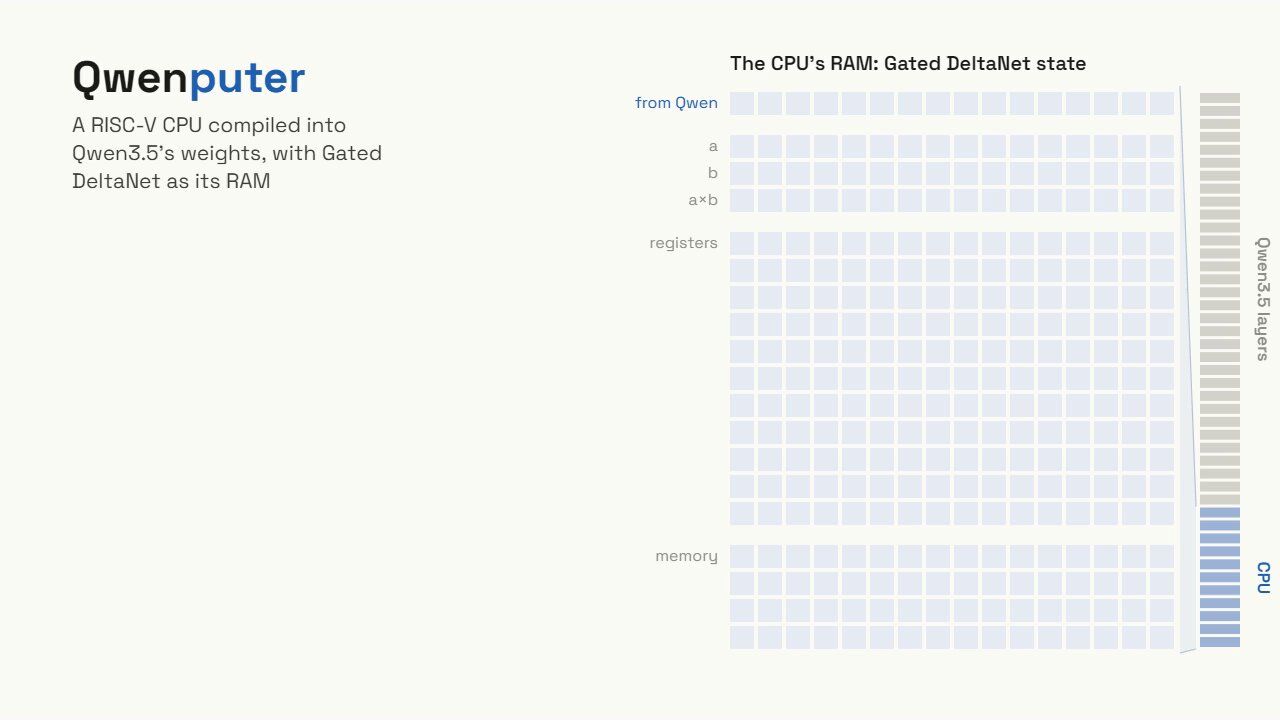
Meet Qwenputer: a stock Qwen3.5-4B model with a working 32-bit RISC-V CPU compiled directly into its weights. Developer div (@divagr1925), a Qwen ambassador, unveiled the project on Oct 28, and the official Qwen Developers account amplified it within hours. It is not a plugin, a sandbox or an external tool. It is 11 transformer layers inserted ahead of Qwen's own, and none of their weights were learned. A compiler computed every one of them.
The trick is memory. Qwen3.5 uses Gated DeltaNet layers in three of every four blocks, and those layers carry a running state that can be overwritten a row at a time. Qwenputer treats each row as a memory cell, so the CPU keeps its code, data, registers and program counter inside the model's own attention state. The core is RV32IM with the Zba extension and a bignum coprocessor: 256 KB of code ROM, 128 KB of read-only data and 32 KB of RAM. It runs C and MicroPython inside the forward passes, passing the official riscv-tests suites.
The payoff is exact arithmetic with no tool call. On DeepMind math benchmarks the plain base model scores 55 to 90 percent, base plus a Python tool reaches 95 to 100 percent, and Qwenputer hits 97.5 to 100 percent with no external runtime. It is slow, running about 3,700 instructions a second per stream at 1.2 to 1.4 tokens per instruction, but the direction matters: instead of predicting an answer, the model computes it. The write-up is at divagr.com and the weights are on Hugging Face.