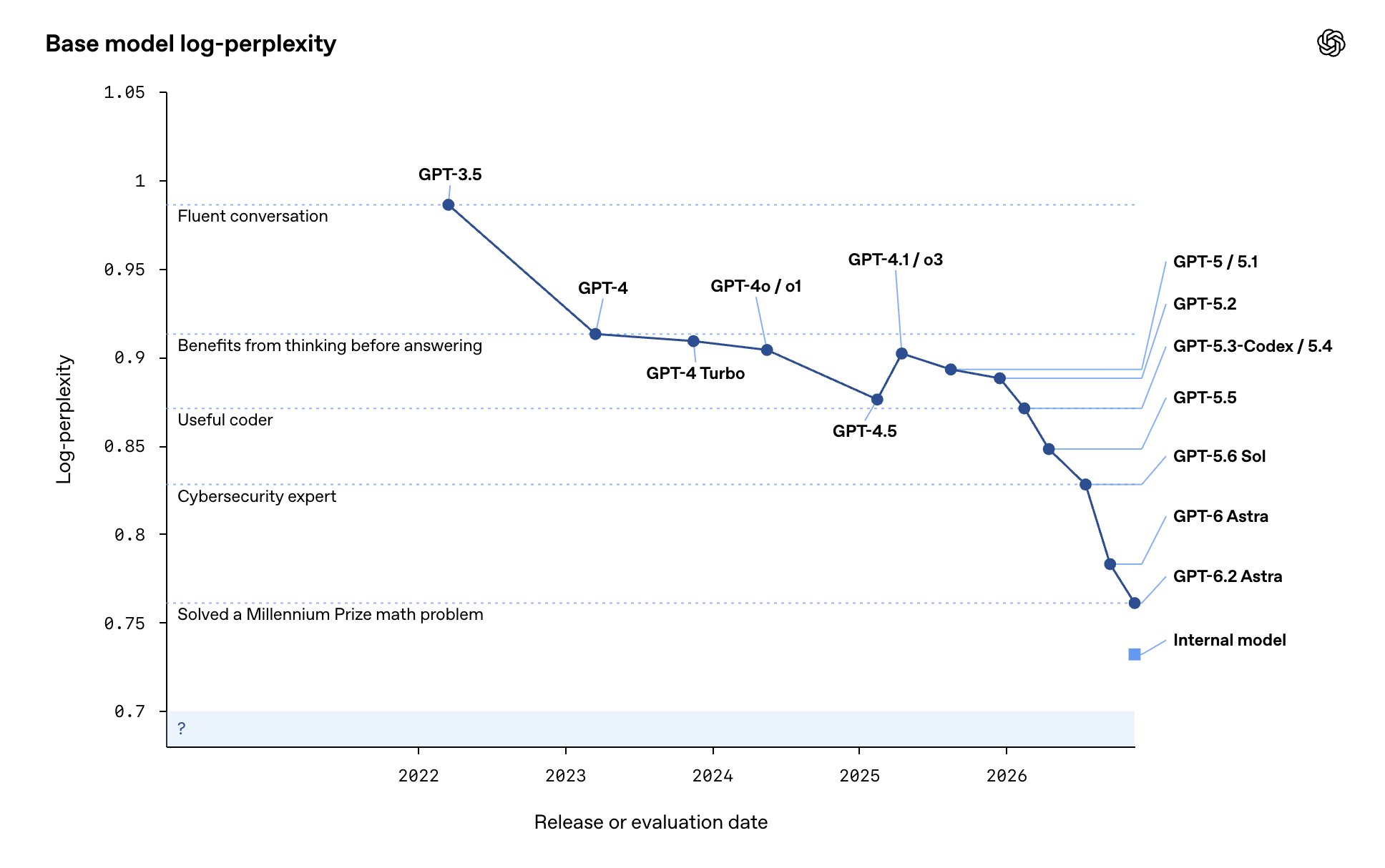
On November 22, OpenAI chief scientist Jakub Pachocki published "Perplexity and Intelligence," a post that does two unusual things at once: it reveals OpenAI's internal pretraining numbers for the first time, and it asks the whole industry to agree on a shared limit for how far models should be pushed. The chart tracks base model log-perplexity from GPT-3.5 at about 0.99 down to GPT-6.2 Astra at about 0.76, with an unnamed internal model lower still at about 0.73. Lower means the model predicts the next token better, and better prediction is what OpenAI treats as the core measure of progress.
Pachocki ties those numbers to capabilities. At 0.99 came fluent conversation and the original ChatGPT. At 0.91, models began to benefit from thinking before answering. Below 0.8, transformative work appeared in cybersecurity and mathematics, including a Millennium Prize level result once the line reached 0.76. He expects the next wave in the 0.68 to 0.7 window, and warns that pretraining research could see an avalanche of fundamental breakthroughs as soon as 2027, faster than monitoring and alignment work can keep up.
The proposal is for common limits, based on perplexity and other measurements, that developers commit not to cross until their ability to understand and monitor AI behaviour reaches a concrete milestone, such as a successor to chain of thought monitors. Sam Altman called it the most important thing OpenAI has published in a while. Not everyone is convinced. Critics argue that capping pretraining mainly pushes effort into post-training, where risky goal seeking tendencies actually emerge, and no other lab had publicly signed on when the post went live.