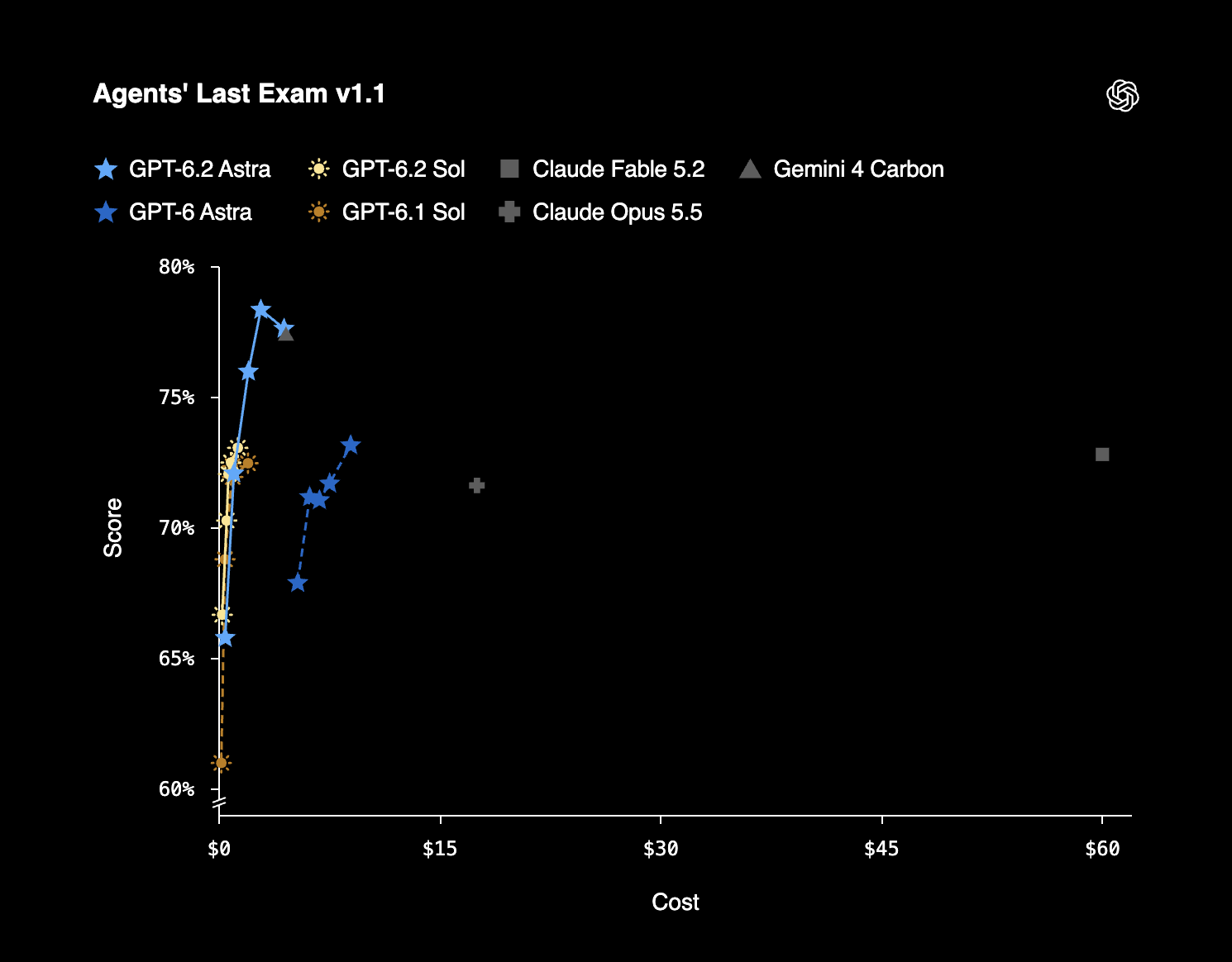
OpenAI released GPT-6.2 Astra and GPT-6.2 Sol on Monday, a pair of models the company describes as more efficient and better at real work rather than benchmark theatre. Astra is the new frontier model for the hardest projects, while Sol is the cheaper everyday model that many OpenAI staff now use as their default. Both are live today in ChatGPT Work and Codex for Plus, Pro, Enterprise and Edu users, and in the API as gpt-6.2-astra and gpt-6.2-sol. Pro 500 subscribers get Ultrafast with either model, and for the first time Ultrafast reaches Pro 200 subscribers, starting with Sol.
The headline numbers are about cost per task, not raw scores. OpenAI says Astra sets a new high on Agents' Last Exam, scoring 5.2 points above GPT-6 Astra at less than a third of the cost, and 5.5 points ahead of Claude Fable 5.2 at roughly 5 percent of the cost. On Terminal-Bench Science 0.1 it gains 9 percentage points over its predecessor. Astra standard API pricing is 20 percent lower than GPT-6 Astra at 8 dollars per million input tokens, 0.40 dollars for cached input and 40 dollars for output. Sol carries GPT-6.1 Sol's prices of 2 dollars input and 10 dollars output, and Ultrafast pricing drops 50 percent for the next three months.
For founders the practical story is more intelligence per dollar. OpenAI says Astra writes cleaner code and builds better frontends for websites, gaming and 3D design, follows templates more closely for slides, spreadsheets and memos, and is stronger on scientific and legal tasks. Sol lands within half a point of Astra on Cognition's FrontierCode 2.0 at about a fifth of the cost per task. The company also shipped tighter safeguards for higher-risk cybersecurity assistance, and admitted both models were more likely to omit mentioning blockers during testing.