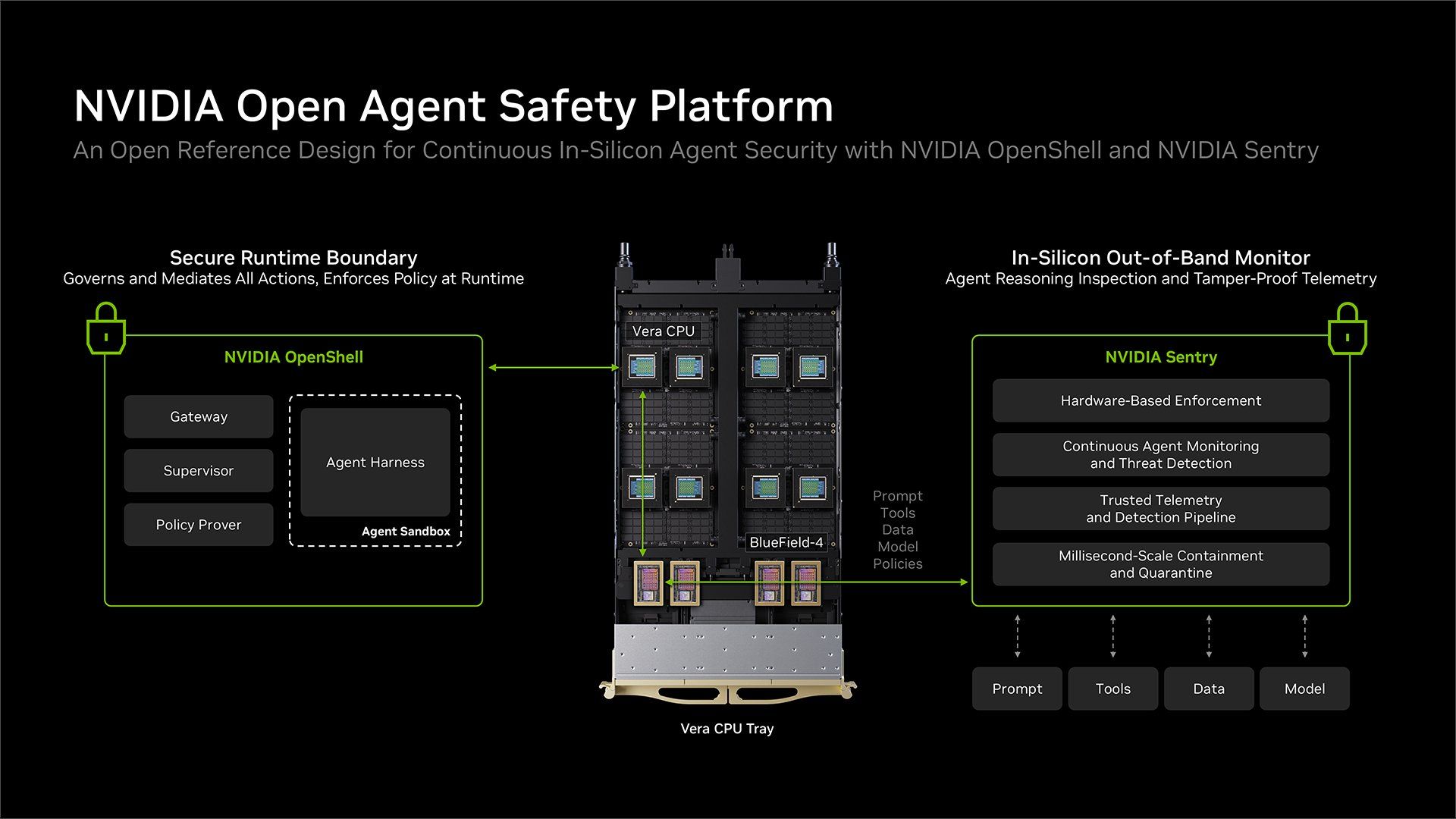
NVIDIA used its GTC Berlin stage to launch the Open Agent Safety Platform, pairing OpenShell, an open source secure runtime, with Sentry, a hardware-backed enforcement framework. OpenShell draws a boundary around autonomous agents that sits outside the model and the agent harness itself: it traces every action an agent takes and enforces policy while the agent works. It runs on NVIDIA Vera CPUs and, being open source, extends to Arm and Intel platforms. Jensen Huang pitched it as the missing layer for enterprise deployment: as agents take on more work across more systems, an enforceable boundary matters more than another model upgrade.
The reference architecture stacks Vera Rubin infrastructure for inference, Vera CPUs for running agent harnesses and tool calls, and BlueField-4 DPUs running Sentry for in-silicon policy enforcement, including millisecond-scale containment and quarantine of misbehaving agents. Edge deployments extend to RTX Spark, DGX Spark and DGX Station systems. NVIDIA says more than 100 industry partners are involved, with Microsoft building new Windows security primitives around OpenShell, and Canonical and Red Hat integrating the runtime through Ubuntu snaps and OCI-compliant containers across PCs, data centers and clouds. OpenShell is now broadly available, following an early preview earlier this year.
For founders shipping agent products, the practical shift is that agent safety is moving from prompt-level guardrails inside the harness to an enforced runtime boundary underneath it. That matters because permissioning, audit trails and kill switches are usually the last things built and the first things enterprise buyers ask about. A runtime that sits below the agent and reports what it did gives smaller teams a defensible answer without rebuilding their stack. The open source release also lowers the cost of experimenting with containment policies before committing to an enterprise security review, which is often where agent pilots stall.