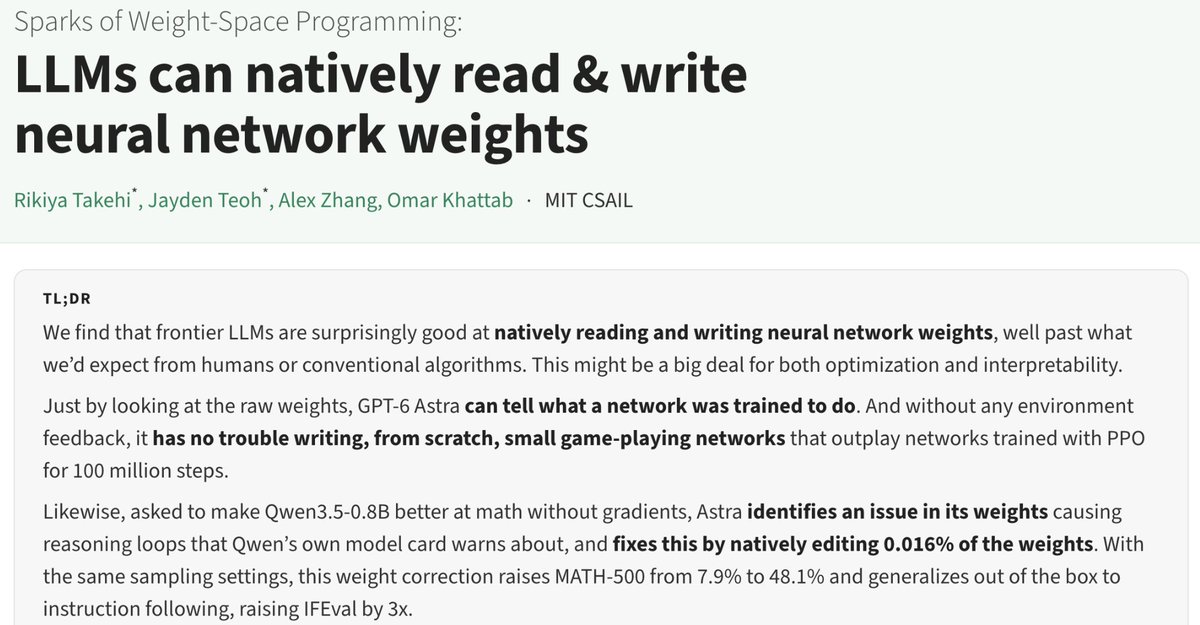
Researchers at MIT CSAIL say a frontier model can treat another network's weights like readable, editable code. In a blog post published on November 2, Rikiya Takehi, Jayden Teoh, Alex Zhang and Omar Khattab report that GPT-6 Astra raised the MATH-500 score of Qwen3.5-0.8B from 7.9 percent to 48.1 percent by directly editing 0.016 percent of its parameters. No gradient descent, no training loop and no fine-tuning were used. The authors call the approach weight-space programming.
The experiments span three abilities. Given a policy of 17,253 weights, Astra identified which of four games it had been trained to play with 99 percent confidence, without running the model or using external tools. In a control task where a trained car never cleared a slope, Astra edited 3.5 percent of the weights in a single reply and the success rate went from 0 to 100 percent. Asked to improve Qwen3.5-0.8B at math, it located reasoning loops that Qwen's own model card warns about and patched them out, lifting GSM8K from 13.8 percent to 67.1 percent and tripling IFEval instruction following.
The authors are careful to frame this as very early results. The networks are small, there is no peer review, and the Qwen edit used a Python kernel to apply the change rather than literally rewriting weights from scratch. Independent replication has not been published. Even so, the direction of travel matters for founders shipping on top of models: if a frontier model can diagnose and repair another model's weights from raw numbers plus a natural language spec, the cost of fixing a deployed model without retraining falls sharply.