Meta Superintelligence Labs released Muse Ember on November 9, its smallest model yet and the first trained with the company's Muse Wonder Full recipe. Meta built it for the repetitive work AI agents do all day: calling tools in sequence, handling coding subtasks, routing requests between models, pulling structured data out of messy inputs and parsing long documents. It covers text, images, audio and video, and it ships with a one million token context window, available now on the Meta Model API and inside Muse Code.
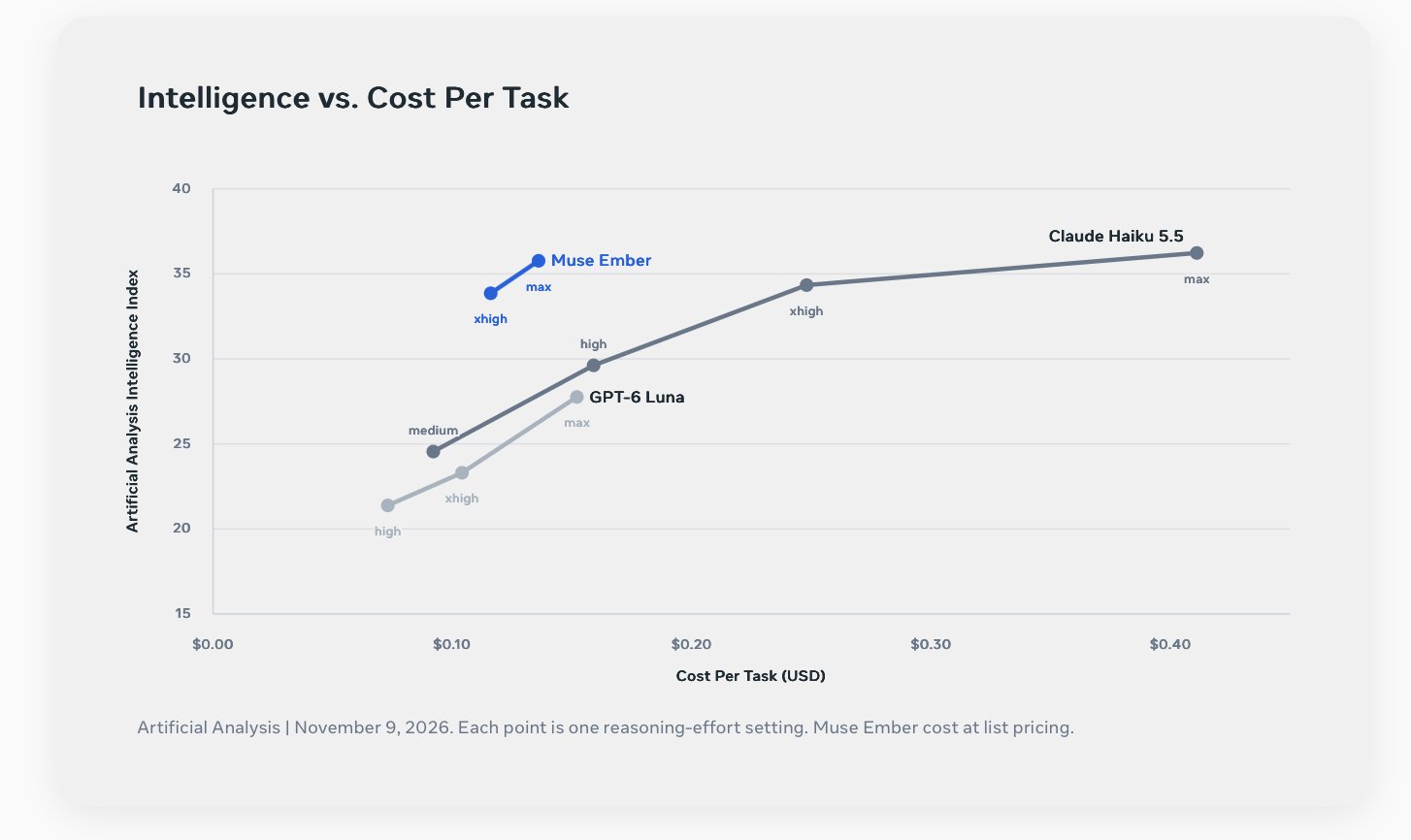
The pitch is efficiency rather than raw scale. Ember costs 0.10 dollars per million input tokens and 0.50 dollars per million output tokens, the same list price as Claude Haiku 5.5 and GPT-6 Luna. Artificial Analysis measures it at 36 on its Intelligence Index at maximum reasoning effort, level with Haiku 5.5 and ahead of Luna on 28, at roughly 0.14 dollars per task against Haiku's 0.41 dollars. On end-to-end business workflows Ember scores 37.8 on AutomationBench against 13.9 for Haiku and 20.2 for Luna. It still trails Haiku on one real engineering benchmark, FrontierCode 2.0, where it scores 27.2 to Haiku's 34.9.
For founders building agents, the practical effect is that the cheap tier just got better. Routing, extraction and tool-calling loops are where token bills pile up, and a model that matches last year's frontier quality at a third of the cost per task changes what is worth automating. Meta says more efficient Muse models are already in training, and the benchmark numbers here come from Meta's own launch materials and from Artificial Analysis, so treat them as vendor and third-party figures rather than independent field tests.