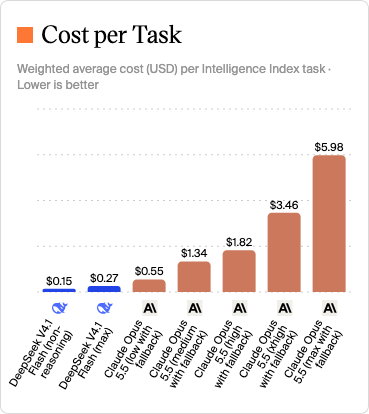
A developer who has run DeepSeek 4.1 Flash daily for a month across a dozen projects says the quiet part out loud: on most real work he cannot tell it apart from a frontier model from Anthropic or OpenAI. The post, "Why Isn't The Industry Freaking Out About DeepSeek 4.1 Flash?", hit the top of Hacker News this week with more than a thousand points and nearly a thousand comments, and the reaction suggests the question stung. The author's claim is not that DeepSeek leads on benchmarks. It is that it is good enough for high-quality unattended work, while costing orders of magnitude less, so the premium tier stops being the default choice.
The economics come from the cache. DeepSeek shrank its KV cache by roughly 437x versus its V1 model, and holding that cache in GPU memory is one of the biggest costs of a long coding session. That is what lets all-day agent runs land under a dollar in expected cost rather than spiralling, and it is why the author treats mindless tasks, exploratory UI testing, and even desktop file cleanup as basically free. For founders building with agents, that changes what is worth automating. A job that was too small to justify frontier pricing suddenly clears the bar.
Frontier labs have a different business model: they need to recoup the cost of training each new generation. The comparison in the post is big pharma against generic manufacturers, with roughly a ninety percent price cut and barely a step down in day-to-day capability. The practical takeaway for builders is a routing strategy. Use a cheap high-volume model for the bulk of agent work, then pull in a frontier model only for the final review or the genuinely hard edge cases, and let the cheap model execute the fixes. Paying top dollar is no longer the same thing as getting the best output.