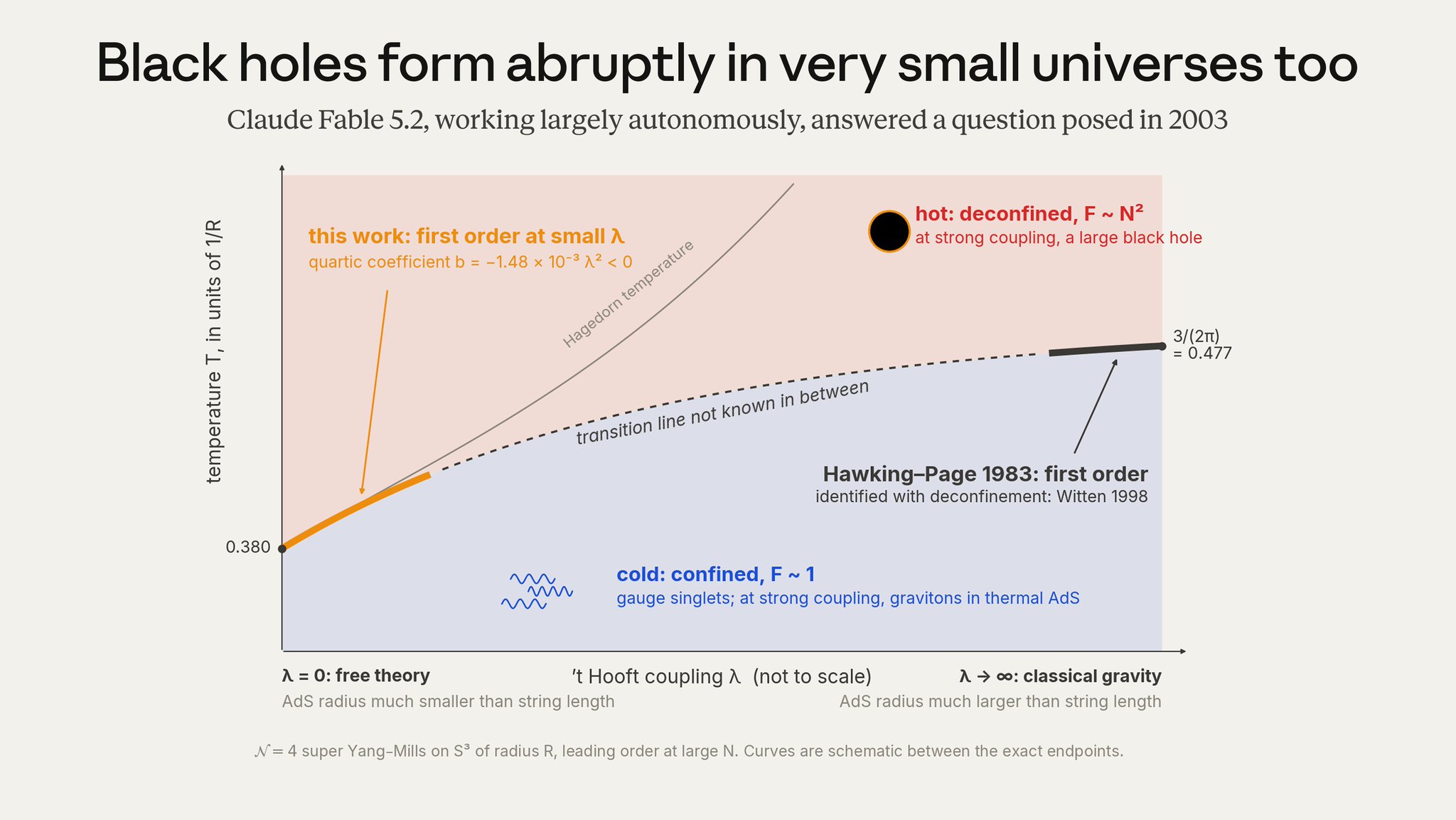
Anthropic says Claude Fable 5.2 has solved two open problems in theoretical physics, both tied to black holes and the search for a theory of quantum gravity. In the first, the model completed a calculation physicists laid out in 2003 to test whether a sudden transition linked to black hole formation also holds in very small universes, where spacetime no longer has a definite shape. More than two decades later, Claude showed the transition is abrupt there too, matching the behavior physicists first described for larger universes back in 1983. Its preprint reports the transition is first order at small coupling, with a quartic coefficient of minus 1.48 times 10 to the minus 3 times lambda squared.
The second result concerns the modular bootstrap, a 15-year-old technique used to rule out candidate theories of quantum gravity. Claude found the exact limit of the simplest version of that technique and proved the ceiling cannot be lowered, showing that the lightest black hole in three-dimensional quantum gravity can be no heavier than c over Lambda, where Lambda is approximately 9.1266. Anthropic describes the combination of a precise bound and a proof of its optimality as the harder half of the problem.
The work started in August as a side project. An Anthropic researcher asked Claude to draw up a list of interesting open problems in theoretical physics focused on black holes and the bootstrap method. It came back hours later with 22 candidates, and separate agents were set to work on each one, reading each other's progress posts and collaborating when their problems overlapped. They ran in the background for about six weeks with no special setup, and two of them succeeded. Both results are written up in preprints.