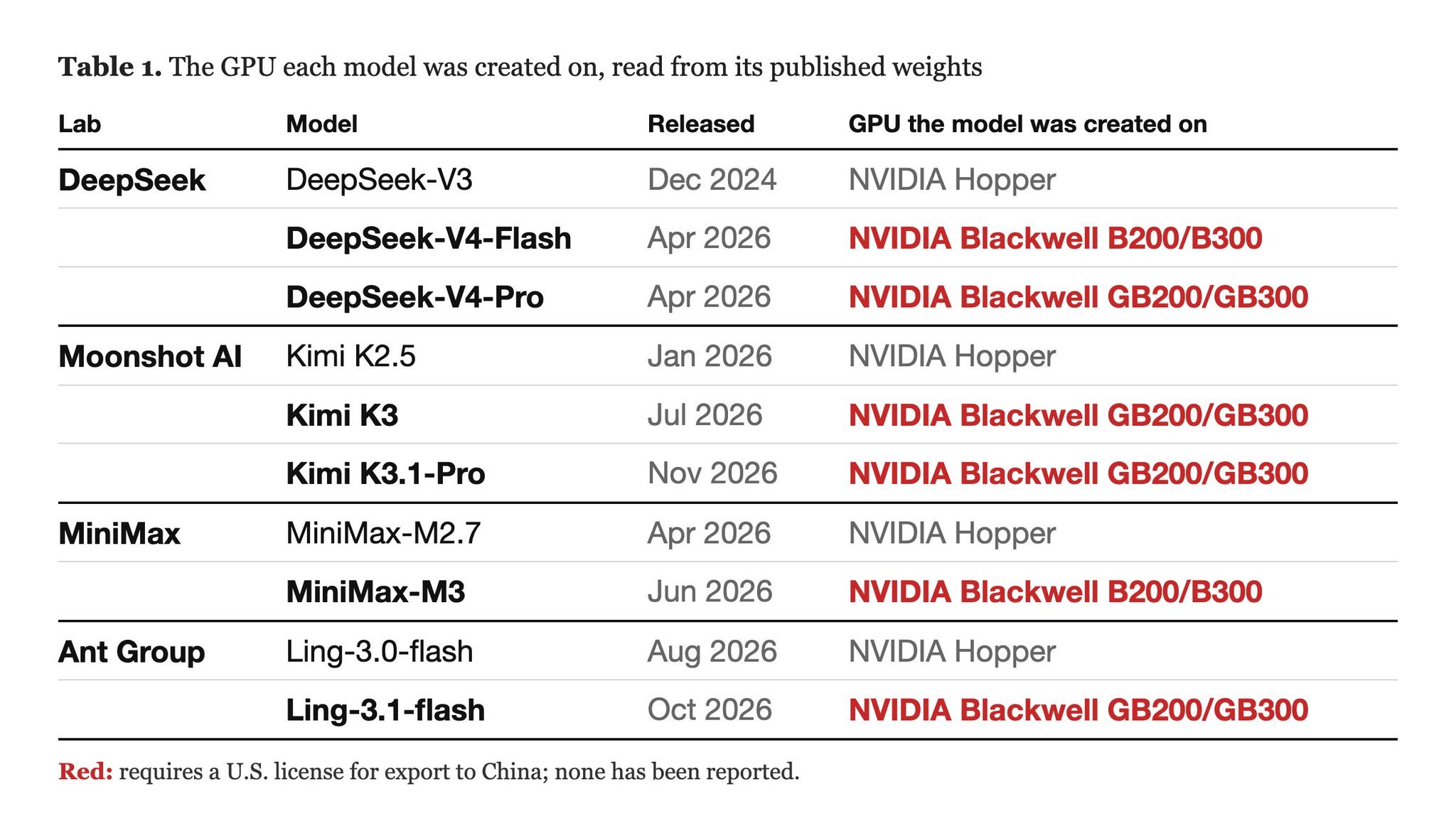
A forensic report published on November 12 by Unemployment Labs says six recent models from four Chinese labs were created on NVIDIA Blackwell chips, the hardware US export rules bar from China. Author Will DePue found numerical patterns inside published model weights from DeepSeek-V4-Flash and V4-Pro, Moonshot's Kimi K3 and K3.1-Pro, MiniMax-M3 and Ant Group's Ling-3.1-flash that match Blackwell processors. The same labs' older releases, including DeepSeek-V3 and Kimi K2.5, read as Hopper, NVIDIA's previous generation.
The method needs no leaks or insiders. Before training begins, weight values are initialised with a pseudorandom generator called Philox, and PyTorch spreads that work across thousands of threads on the GPU. A chip with more processing units hands the same job to more workers, which changes where those numbers land in the finished weights. Counting the pinned values recovers the thread layout: 148 units for B200 and B300 chips, 152 for GB200 and GB300. Tested against 24 models whose hardware the developer disclosed publicly, the method agreed every time, including NVIDIA's own Nemotron-3 Ultra.
DePue estimates that the five Blackwell runs needed roughly 12,000 GPUs between them, and that the two largest clusters alone would cost 200 to 300 million dollars at about 70,000 dollars a chip. The report is careful about what the fingerprints prove: they identify the hardware that created the weights, not where the chips were located or whether export controls were broken. Most other Chinese labs, including Alibaba's Qwen and Zhipu's GLM, still read as Hopper. The post announcing the findings drew more than 40,000 likes on X within days.