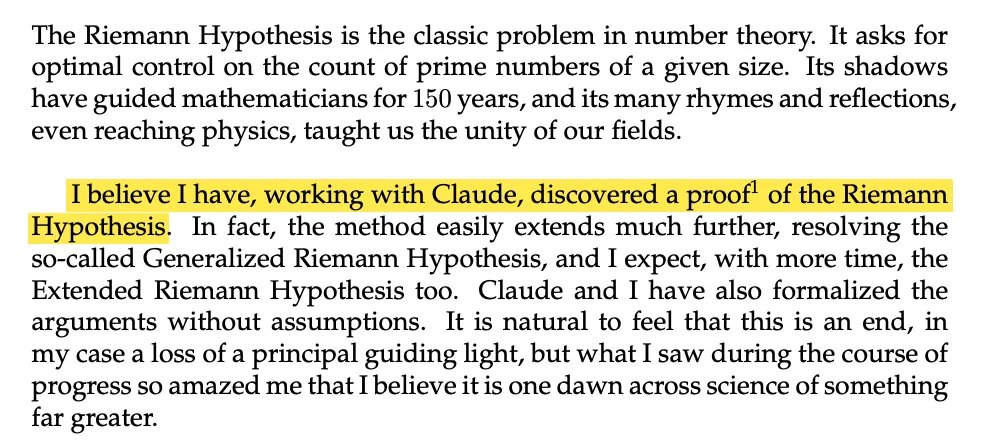
Levent Alpoge, a mathematician on the technical staff at Anthropic, posted a four page note on his website on Friday saying he and Claude discovered a proof of the Riemann Hypothesis. The problem dates to 1859, is one of the seven Millennium Prize Problems, and carries a prize of 1 million dollars. In the note he writes: "I believe I have, working with Claude, discovered a proof of the Riemann Hypothesis." He says the same method resolves the Generalized Riemann Hypothesis and should extend to the Extended Riemann Hypothesis with more time.
The proof was not published as a paper. Written out for humans it runs past 250,000 pages, so Alpoge released 14 parts of Lean code instead, a format where a compiler checks every logical step. Colleagues moved fast. Andrew Sutherland at MIT compiled the formalization independently and told Scientific American that the chance anything is fishy is approximately zero, while Kevin Buzzard of Imperial College London wants one last check that no symbol in the statement was quietly redefined. Alpoge credits Claude with the key move, a chain of square root of X theta lifts, and says the model far outpaced him near the finish line.
Founders should read this as a workflow story, not just a math story. Generation is cheap now, and verification is the bottleneck, so a machine checked proof is the only way work this size can be audited at all. It also landed in a messy week for Anthropic, whose shares fell about 10 percent the day after its IPO, and alongside a separate human proof of the generalized result by Alessandro Masullo after 12 years of work. If the Lean archive holds, the most famous open problem in mathematics fell twice in one week, once to a person alone and once to a person working with an AI.