Alibaba released Qwen4-Max on November 16, calling it the most capable model in its Qwen family to date. The flagship is a sparse mixture-of-experts system with 2.4 trillion total parameters but only 71 billion active per token, roughly 25 percent fewer activated parameters than its predecessor at the same scale. It handles text, images and video through native vision, and it ships with a one-million-token context window plus a 384,000-token maximum output.
The headline number is cost. Alibaba says Qwen4-Max matches or beats Qwen3.8-Max while using up to 50 percent fewer tokens, dropping the average cost per task on its internal Work360 benchmark from USD 4.43 to USD 1.67, a reduction of roughly 60 percent. API pricing lands at USD 1.50 per million input tokens, USD 4.50 per million output tokens, and USD 0.075 per million for implicit cache hits, which the company says is 70 percent cheaper than before.
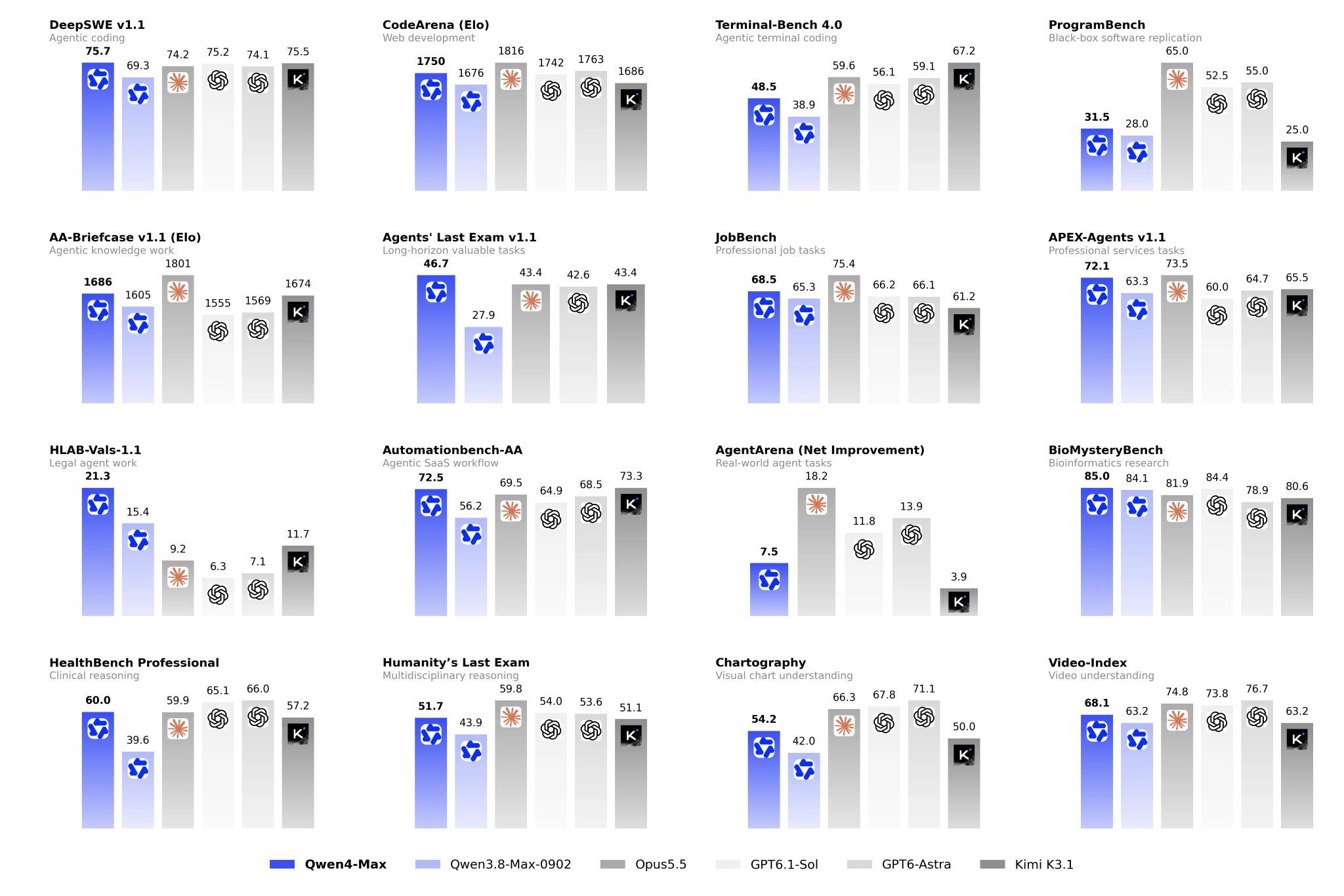
Alibaba reports that Qwen4-Max scores 52.69 on Work360, about 10 percent above its predecessor, and ranks sixth on the Code Arena leaderboard. Independent verification is thinner. Benchmark watchers note the model trails Opus 5.5 on some coding and vision tests, and none of the launch scores have been reproduced externally yet. Qwen4-Max is live now on QwenCloud, Qwen Studio, QwenWork and Qoder, with open weights promised for smaller Qwen4 models.