Most warehouse and inventory platforms now say they have AI. The useful question is what that AI does on a normal Tuesday morning, and what it costs to get access to it.
This guide looks at eight platforms that a small warehouse, a growing 3PL or an ecommerce seller running its own pick-and-pack can realistically buy in 2026. Every price below was read from the vendor's own pricing page, and where a vendor publishes nothing we say so rather than guessing.
The pattern worth knowing before you read on: the cheapest tools in this market now ship genuine AI assistants, while the most impressive AI - robots that count stock and move pallets on their own - is sold as a quoted project rather than a monthly subscription.
What "AI" actually means in warehouse software in 2026
Across these platforms, four kinds of AI turn up again and again: demand forecasting that suggests what to reorder, pick-path optimisation that sends a picker on a shorter route, document reading that turns supplier paperwork into structured data, and an assistant you can ask questions in plain English.
What almost never appears is a fully autonomous warehouse. Robotics vendors sell that as a project with a quote, hardware and an integration phase - not as a plan you can cancel at the end of the month.
1. Cin7 - forecasting and order management for multichannel sellers
Cin7 runs inventory, order management, point of sale and warehouse operations for brands selling across ecommerce, wholesale and marketplaces. It says it processes more than 125 million orders a year for around 8,500 customers.
The AI is spread across features rather than one badge: ForesightAI for buying decisions, AI Operations for task automation, an Ask Me Anything layer for queries, and Intelligent Document Recognition that reads supplier documents.
Pricing is published in US dollars, excluding tax: Standard $349 per month, Pro $599 and Advanced $1,199. The top tier is the one that adds warehouse management. See cin7.com.
Why it made the list: the most complete AI feature set with a published price.
2. ShipHero - warehouse management priced by shipment volume
ShipHero is a warehouse management system built for ecommerce brands and 3PLs. AI Picking routes pickers through the building, AI Path Optimization batches their work, and an AI Toolkit with MCP access is included free on every plan.
It charges by volume rather than seats: plans start at $15,000 a year, with a first-year ballpark of $21,000 pay-as-you-go or $20,300 prepaid, plus one-time onboarding from about $5,000. Extra DTC shipments cost $0.24 each, or from $0.22 prepaid. Details at shiphero.com/pricing.
Why it made the list: volume pricing gets cheap at scale, but the entry point is a real commitment.
3. inFlow - mid-market inventory with a built-in report assistant
inFlow covers purchasing, sales, barcoding, a B2B customer portal and light manufacturing for small product businesses, from solo founders to teams of roughly 50 people in more than 90 countries.
Its AI is the built-in Report Assistant, which answers plain-English questions about your orders and stock, plus an MCP connection so you can work with inFlow from Claude.
US pricing runs from Lite at $129 a month through Core $379, Pro $629 and Max $879, with manufacturing plans from $199 and add-ons such as $29 per extra team member and $49 for API access. Annual billing is cheaper - Lite is $1,188 a year. inflowinventory.com
Why it made the list: useful AI without jumping straight into an enterprise contract.
4. SKULabs - month-to-month fulfilment with AI on the higher tiers
SKULabs handles multichannel inventory, guided barcode scanning, batch picking and shipping for small and mid-sized sellers and 3PLs, on month-to-month billing with no contract or onboarding fee and a 30-day money-back guarantee.
AI sits in the upper plans. Automation arrives with the paid tiers, and Pro and Enterprise are described as AI-driven order fulfilment and AI-driven scalability.
Published prices are Starter $299 a month, Basic $499, Growth $799, Pro $999 and Enterprise $1,999, with unusually clear overage rates such as $0.20 per extra order and $120 per extra user on Starter. See skulabs.com/pricing.
Why it made the list: the most transparent usage costs of any vendor here.
5. Veeqo - the cheapest AI-assisted shipping layer
Veeqo, owned by Amazon since 2021, manages listings, inventory and shipping across marketplaces. It has a Seller Assistant AI agent for warehouse and fulfilment tasks, an MCP connection into ChatGPT and Claude, picking-path optimisation, and Vera, an AI support agent.
Pricing starts at $19 a month for the shipping plan, while the tier that adds inventory management starts at $350 a month. There is also a free plan. veeqo.com/pricing
Why it made the list: AI help at a price a two-person operation can actually justify.
6. Zoho Inventory - the cheapest agent layer
Zoho Inventory covers orders, warehousing, purchase orders and customer portals for small businesses, and its AI is deeper than the price suggests: Ask Zia answers inventory questions with direct links to take action, Zia invoice insights flags overdue and high-risk customers, and an MCP layer lets you build agents that handle routine warehouse tasks.
Prices are per organisation, billed annually: Standard $29 a month for 500 orders, then Premium $79, Plus $129 and Enterprise $249. Add-ons include $7.50 per extra user, $10 per location and $124.17 for advanced warehousing. zoho.com/inventory/pricing
Why it made the list: enterprise-style AI agents on a small-business bill.
7. Megaventory - a priced baseline with no AI at all
Megaventory is a cloud inventory and order system for small distributors, covering consignments, invoicing, multiple locations and multi-currency. Its pages make no AI claims anywhere, which makes it a clean comparison point rather than a weakness.
There is one published plan: Pro at $135 a month including five users, 50,000 transactions and up to 20 locations, with extra users at $45 a month each. megaventory.com
Why it made the list: solid inventory control without paying for AI you will not use.
8. erplain - modular pricing that shows what each feature costs
erplain is a small-business inventory, sales and purchasing system from France, with optional B2B store and Shopify modules. Like Megaventory, it advertises no AI features, so the extra money buys process, not prediction.
Three plans billed annually: $69 a month for the essentials, $163 to support growth and $304 for advanced needs, plus $16 per extra user and module add-ons from $11 for Shopify up to $75 for the B2B store. erplain.com/en/pricing
Why it made the list: a modular price list that shows exactly what each capability costs.
Where the AI is impressive and the price is a secret
The most advanced warehouse AI is sold by quote, not subscription. Logiwa positions itself as an AI-native WMS, Dexory sells robots that scan racking with physical AI, Locus Robotics puts LocusIntelligence behind its robotic fleet, and Plus One Robotics sells AI-powered vision for depalletising. None publish a price, so plan for a pilot, hardware and an integration project rather than a line item.
How to choose without overpaying
The pricing shape matters more than the feature list. Flat subscriptions, which run from $19 to $1,999 a month in this group, suit low or unpredictable volume. Volume pricing such as ShipHero's per-shipment model falls fast per unit as you grow, but the $15,000 floor means it only makes sense above a certain throughput.
Then check which tier the AI sits on. Veeqo, inFlow and Zoho Inventory bundle it from the entry plan, while Cin7 and SKULabs keep their best AI in the upper tiers you may never need.
Finally, match the AI to your actual bottleneck: forecasting if cash is stuck in stock, pick-path optimisation and scanning if labour is the constraint, and document reading if supplier paperwork is eating your admin hours.
The honest takeaway
In 2026 the AI in small-warehouse software is modest but real. It forecasts demand, shortens picking routes, reads documents and answers questions about your stock. That is worth paying for, selectively.
Buy the pricing shape that fits your volume, confirm the AI is on the tier you can afford, and treat autonomous warehouse robotics as a project for an operation much larger than yours.
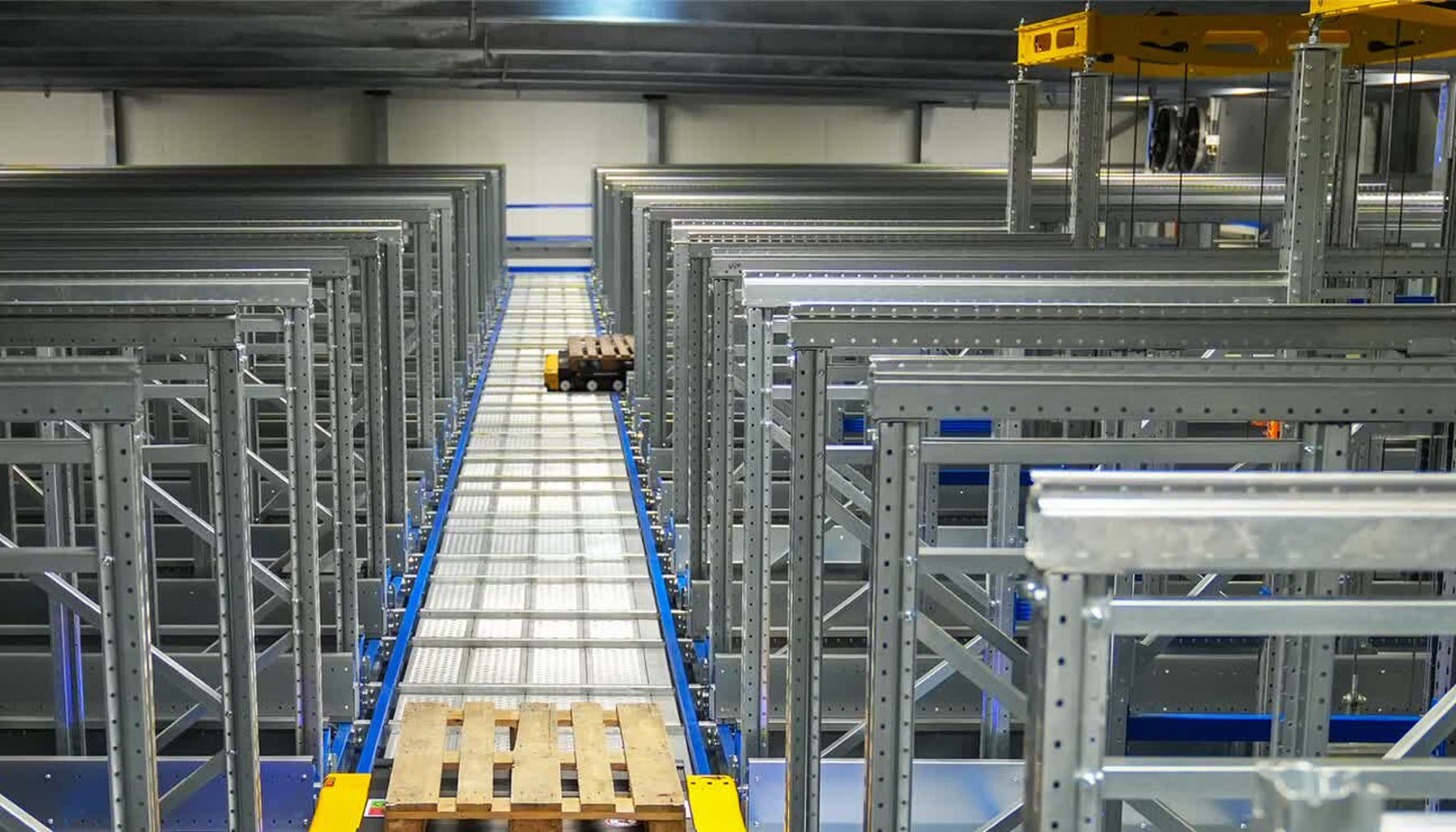
Cover photograph: QmcBeQ3G7DZCmY84uPgT, CC BY 4.0, via Wikimedia Commons.