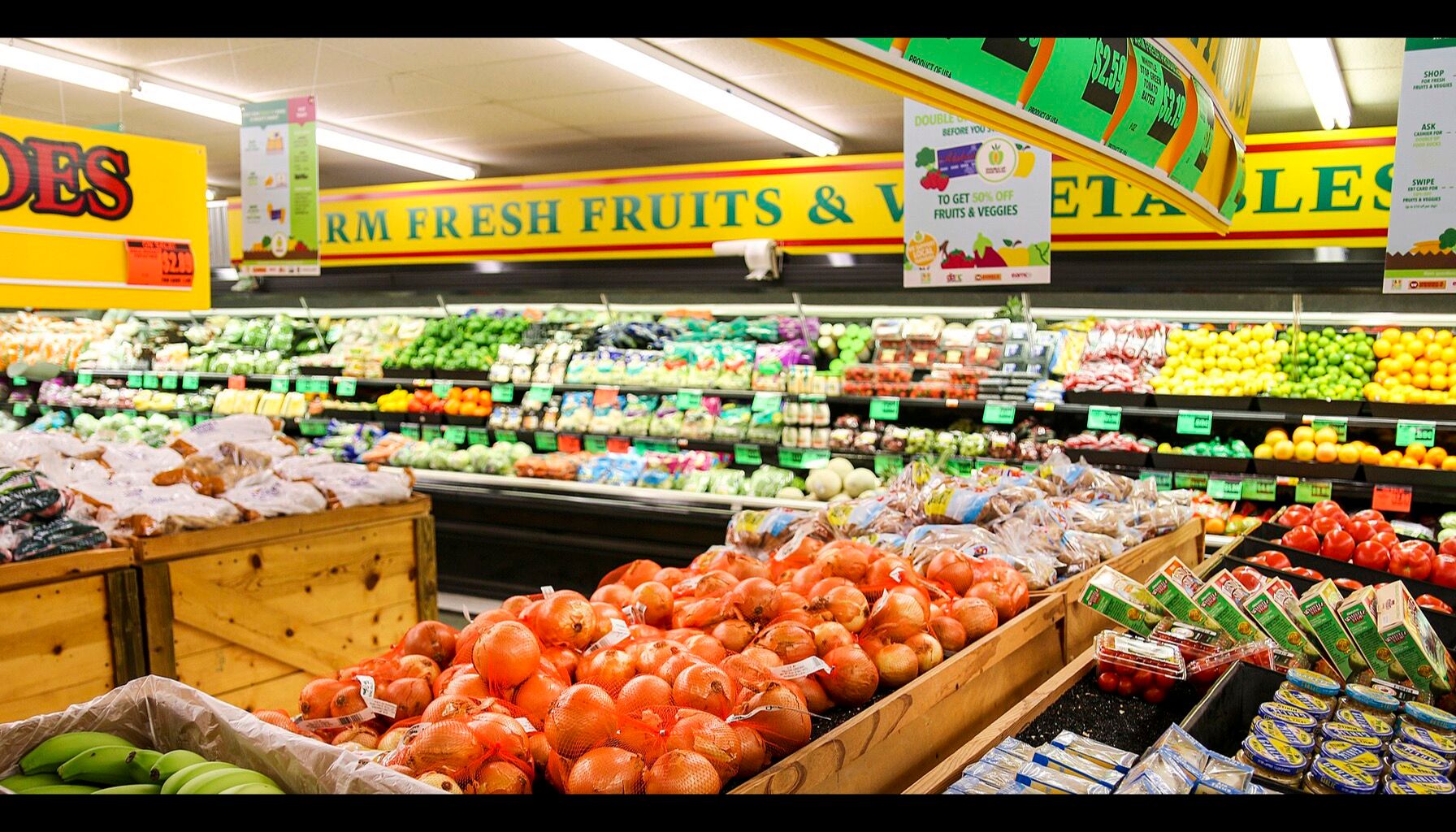
Walk into a supermarket in 2026 and most of what you can see has not changed in twenty years: shelves, trolleys, a till. What has changed is quieter. A camera in the self-checkout lane is costing the basket without a barcode, the reorder that stopped a shortage was calculated by a model, and the promotional price on the shelf edge was set by software.
That is genuinely useful AI, and it is operational rather than conversational — it shortens the queue, finds the gap on the shelf and gets the order right. The awkward part is that the vendors who do it best publish the least about money. So here is the market split in two: the platforms that publish a price, and the AI-first systems that do not.
Where the AI Actually Sits in a Grocery Store
Grocery AI shows up in three jobs. Checkout: vision scanners that recognise loose produce without a barcode, and checkout-free stores where you simply walk out. The shelf: scanning robots and fixed cameras that check availability, spot misplaced stock and flag a wrong price tag. Forecasting: predicting what each store will sell next week and turning that into a replenishment order.
The three jobs carry very different price tags and are sold by different companies. Checkout and shelf systems are usually hardware-plus-subscription deals aimed at chains, which is why almost none of them publish a rate card. The general retail platforms underneath a small shop's till — where AI is one feature among dozens — nearly all do.
1. Square for Retail — AI Bundled Into a Free Plan
Square is the fastest way to put a modern till into a single shop, and the AI is not a separate purchase. Signing up is free, and the paid plans add the inventory features a real shop needs: item variants, purchase orders, multi-location stock and team permissions.
Pricing is published per location: Free at $0, Plus at $49/month and Premium at $149/month, with card processing charged on top. Square's pricing page calls Squaremates “the AI business partner built into Square”, lists AI-powered insights across sales trends and product performance, and includes AI voice ordering that answers calls and turns them into orders.
Why it made the list: the only platform here where a working AI assistant comes bundled rather than sold as an add-on.
2. Lightspeed Retail — AI Sold as a Paid Add-On
Lightspeed Retail is aimed at independent shops with genuine inventory — barcodes, variants, several suppliers, sometimes two locations. Its AI appears twice: Lightspeed AI in the platform menu, and AI Doc Import, which reads a supplier invoice or delivery note and drafts the purchase order for you.
The X-Series pricing page lists three plans: Basic at $89/month, Core at $149/month and Plus at $289/month, each including one register, with extra locations and registers charged on top. AI Doc Import is an add-on on Basic and Core and included on Plus. Lightspeed Payments takes 1.5% on card-present sales, and Insights adds forecasting and order recommendations.
Why it made the list: the clearest case of AI sold as a line item — check that box before choosing the cheaper plan.
3. Korona POS — Priced Per Terminal, No AI Claims
Korona POS prices by the till rather than by the store, which suits a shop running two lanes and a back-office desk. The plans are cumulative, and the vendor publishes the whole comparison instead of hiding behind a quote form.
Core is $59 per terminal per month, Retail is $79 and Plus is $99, with annual billing discounted. Modules are priced openly too: Invoicing is $10 per register per month, Ticketing $50 per entry gate and a franchise module $30 per franchisee. No setup fee, no forced contract — and no AI claim anywhere on its pages.
Why it made the list: a priced, honest baseline that shows what a shop's till costs before AI enters the conversation.
4. ERPLY — A Grocery Tier Priced Per Store
ERPLY sells point-of-sale, inventory and order management to shops and small chains, and its pricing page names a grocery package outright: a “Giftshop & Grocery chain” tier for shops with small stock, alongside a multichannel tier for retailers selling online and offline from one stock pool.
The grocery tier is $59 per store per month, or $49 per store billed annually, including one user and one till with basic reports. Multichannel is $199 per store monthly or $179 annually, adding warehouse licensing, purchase and receiving, barcode labels, cycle counts and a Shopify integration. Bigger retailers are quoted: POS for NetSuite from $1,800, and franchise and chain from $3,500.
Why it made the list: one of very few vendors that prices a grocery package per store and publishes the number.
5. Clover Retail — Hardware and Software, Published Together
Clover sells retail systems as device bundles rather than pure software, which makes it the comparison to run when you are replacing hardware at the same time. Each bundle pairs a terminal with a software plan and a card rate.
Basic is $16/month for 36 months, or $349 outright, on the Starter software plan at 2.6% + 10¢ card-present. Standard is $180/month for 36 months or $1,899 plus $84.95/month, and Advanced is $240/month for 36 months or $2,648 plus $104.90/month, both on Retail Growth at 2.3% + 10¢. Inventory management, loyalty and a branded website arrive at Standard. No AI feature is named on the page.
Why it made the list: hardware, software and card rates on one page — and no AI claim it cannot back up.
6. SpotOn Retail — Lowest Software Fee, Restaurant-Side AI
SpotOn undercuts most of this list on the software fee, and publishes rates rather than a quote form. A terminal package is $25/month for software with $200 of hardware; adding a business website takes it to $90/month.
Card-present processing starts at 2.45% + $0.15 for most transactions, with keyed-in payments higher. Read the AI copy carefully, though: SpotOn's named AI assistant belongs to its restaurant product rather than the retail line, so a shop buying the retail package should treat it as a priced platform without a shipped AI feature of its own.
Why it made the list: the cheapest published software fee here — as long as you notice where the AI copy is aimed.
7. The AI-First Systems — Excellent, and Quote-Only
Mashgin builds self-checkout stations that use multiple 3D cameras to model each item and identify it without a barcode. Its pages claim “unmatched AI accuracy” and openly acknowledge that accuracy falls to 80–90% when a rush of customers crowds the scale. Mashgin publishes no price at all.
On the shelf, Simbe Robotics sells Tally, a robot that walks the aisle several times a day checking availability and price accuracy, while
Focal Systems takes the fixed-camera route with what it calls Shelf AI. Both are chain-scale purchases, and neither publishes a rate card.
Zippin attacks the same problem as Mashgin from the other direction — checkout-free stores where sensors and machine learning work out what a shopper picked up.
RELEX Solutions is the forecasting layer behind many large grocery chains, describing itself as “an AI-native platform for end-to-end planning” that combines built-in AI with agentic AI. It is quote-only too.
The honest version: for a single shop these are not realistic purchases, and for a chain the only comparable number is cost per store per month — ask for it in writing before the pilot.
How to Choose Without Sitting Through Five Demos
Start with the till, not the AI. If your point-of-sale cannot do purchase orders, stock counts and multiple locations, a shelf robot will not fix that — and the platforms above start between $0 and $99 a month.
Then match the AI to the job you actually have. Queues point to self-checkout or faster scanning, gaps on the shelf point to shelf-scanning, and over-ordering points to forecasting, which is a data problem before it is a software problem.
Finally, price the add-ons. Lightspeed's AI Doc Import costs extra on its cheaper plans, Korona's modules are priced separately, and card rates across this list range from 1.5% to 2.6%. Cheap software sitting on an expensive card rate is not cheap.
The Honest Takeaway
Grocery is one of the few retail categories where AI is already doing real work rather than sitting on a homepage as a badge: the checkout camera and the shelf scan are genuinely useful, and forecasting quietly saves more money than either.
It is also a market that has learned not to publish prices, especially in vision and robotics. So budget from the rate cards for the point-of-sale platforms, treat the checkout and shelf vendors as a pilot rather than a purchase, and if you only ever get one number in writing, make it cost per store per month.