Agriculture is one of the few industries where AI arrived with an obvious job to do. Land is expensive, inputs are expensive, and the decisions that decide the year — when to irrigate, where disease starts, how much nitrogen to apply — rest on data most farms already collect by hand.
The catch is pricing. Farm software is sold three different ways and the units don't compare: a flat monthly fee per farm, a rate per hectare, and an annual per-acre contract you can only get by booking a call. A $30-a-month platform and a $0.75-per-hectare platform can cost the same farm very different amounts.
Below are eight platforms worth knowing in 2026, with prices read from the vendors' own pricing pages this week. Six publish real numbers. Two don't, and we say so rather than guess.
What Farm AI Actually Does
Two kinds of AI show up on farms. The first reads imagery — satellite, drone or aircraft — scanning for crop stress, pest pressure, weed patches and irrigation need. The second sits inside the admin layer: receipt scanning, invoice capture, chat support, and plain-language reports answered over your own records.
The distinction that matters when you're buying is simpler: AI you can pay for today at a published rate, versus AI that exists only behind a demo request. Both are below, clearly labelled.
1. Farmbrite — The Small-Farm Baseline
Farmbrite keeps livestock records, crop plans, inventory, tasks and basic accounting in one place, and splits its plans by what you actually run: livestock only, crop only, or a mixed operation.
Livestock plans cost $29, $49 or $79 a month; crop plans $29, $39 or $59; complete plans $59, $79 or $109. Annual billing saves roughly two months ($290 to $1,090), and there is a $119-a-year land add-on. You can see the tiers at Farmbrite's pricing page.
Why it made the list: the cheapest full farm-management baseline with published pricing, and no AI premium baked into the bill.
2. Tend — AI Included, Metered by Credits
Tend covers crop planning, tasks, sales, accounting and inventory, and presents itself as all powered by AI in one seamless platform. There is a free tier, and the paid plans bundle AI automation credits rather than selling AI as an upgrade.
Pro is $30 USD a month and Ultimate $75, with Enterprise from $400 a month plus a $250 one-time concierge onboarding fee. The AI allowance scales with the plan: 25 automation credits a month on Pro, 500 on Ultimate, 2,500 on Enterprise and 10,000-plus at the top. Plans are laid out at tend.com.
Why it made the list: the clearest published link between farm AI and what it costs each month.
3. Farmonaut — Priced by the Hectare, From $4.99
Farmonaut watches fields from satellites and converts the imagery into irrigation, pest, disease and nutrition advisories plus yield forecasts, with API access on every plan.
Plans are sized by the land monitored: Mini $4.99 a month for 5 hectares, Basic $29.99 for 30, Standard $64.99 for 80, Premium $224.99 for 300, and Elite Enterprise $949.99 for 1,500. The per-hectare rate falls from $1.00 to $0.63 as you scale, and annual billing removes two months. Rates are published at farmonaut.com/pricing.
Why it made the list: it is the only vendor here that shows exactly how the price scales with your acreage.
4. Bushel Farm — Annual Pricing, No Sales Call
Bushel Farm is grower record-keeping: rainfall history, field mapping, soil maps, futures prices, profit and loss, and marketing reports. It is built for grain operations already using Bushel for payments and bids.
Rainfall is $75 a year, Lite $199 and Essentials $599, with machine data connections — pulling planter and combine data into the platform — a $999-a-year add-on. Above 20,000 acres is custom. The tiers sit at bushelpowered.com.
Why it made the list: published annual prices at grain-farm scale, including the add-on most vendors hide.
5. Traction Ag (Formerly Conservis) — Field-to-Finance Accounting
Traction Ag is what Conservis became. It handles the money side of farming: invoices generated from land agreements for sharecrop and custom work, scale tickets, Schedule F and 1099 preparation, plus payroll integration.
The three plans are $95 a month or $950 a year, $195 or $1,950, and $395 or $3,950 — about $79, $162 and $329 a month annualised — with 15% off the first year. Nothing on its pages claims AI at all, which makes it a clean benchmark. See tractionag.com.
Why it made the list: financial software that publishes its prices, and a fair baseline for judging AI markups elsewhere.
6. Climate FieldView — Free to Start, $649 a Year to Upgrade
FieldView, owned by Bayer, is the digital agronomy layer that sits on top of your field data: a data inbox, field records, and sharing with your agronomist.
Basic starts at $0.00 a year — it is genuinely free — and Plus starts at $649 a year and adds advanced analytics with improved yield recommendations. The comparison is at climate.com.
Why it made the list: a free tier from a major vendor is the cheapest way to find out whether field data changes your decisions.
7. Taranis — Leaf-Level AI, Quote-Only Pricing
Taranis describes its platform as the agriculture industry's first generative AI-powered agronomy engine, and says its models are trained on more than 500 million data points. It reads drone and aircraft imagery down to individual leaves and weeds, and its Ag Assistant answers agronomy questions in plain language.
What it will not tell you is the price. Subscriptions are annual and per acre, and no figure appears anywhere on taranis.com.
Why it made the list: the most advanced crop-level AI in this guide, attached to the least transparent pricing.
8. CropX — AI Irrigation Advice, Also Quote-Only
CropX combines soil sensors with weather, crop and satellite data, and says its AI and predictive agronomic models prioritise alerts and recommend irrigation and fertiliser actions field by field. There is also a service-provider tier for agronomists running multiple client farms.
Its pricing route returns a 404 and hardware plus subscription is quoted per deployment, so budget for a sizing call rather than a checkout. Background is at cropx.com.
Why it made the list: sensor data is the strongest evidence base in farming, and the hardest thing to price from a website.
The Tools That Won't Publish a Price
Three platforms you will find in most farm-tech searches publish no number at all: EOSDA Crop Monitoring, whose own copy describes proprietary AI algorithms turning satellite imagery into decision reports; Cropin, which sells AI agents and a chat assistant called OrbitAI; and OneSoil, whose AI Agronomist reads every field, every day. All three quote by region or hectares, which is the honest reason a single figure cannot exist.
AgriWebb is a partial exception. Its livestock tiers (Essentials, Compliance, Performance) are priced through a per-head calculator that shows $0 until you type in your animal numbers, and prices exclude GST. What is published is the one-time setup: Kickstart from $200, Essentials from $500, Professional from $1,000 and Corporate from $4,000. See agriwebb.com.
How to Choose Without Sitting Through Five Demos
Start with the unit, not the feature list. Per-farm pricing (Farmbrite, Tend, Bushel Farm, Traction Ag) is predictable and easy to budget. Per-hectare pricing (Farmonaut) gets cheaper per acre as you grow, so it suits operations planning to expand. Per-acre annual contracts (Taranis, Semios) only pay off if the advisory changes a decision worth more than the fee — an extra fungicide pass across 500 acres, for example.
Then check what is metered. Tend's AI credits, Bushel's $999 machine data connection, Farmbrite's land add-on: the base price is rarely the final bill, so ask what happens when you exceed the allowance.
Finally, run one season on the free or cheapest tier before signing an annual contract, and ask who owns the data and whether you can export it. Field records are the asset you are actually building, and software with no export option is a lock-in however good the AI looks.
The Honest Takeaway
Farming has two software markets wearing the same label. The priced group — Farmbrite, Bushel Farm, Traction Ag and FieldView — is mostly record-keeping, and several of those vendors make no AI claim at all. The AI-forward group — Tend, Taranis, CropX, EOSDA, Cropin and OneSoil — either meters the AI or hides its rate behind a sizing call.
If you want farm AI you can budget for, Tend is the only platform here that publishes both a monthly price and an AI allowance in public. If you want to know whether field-level AI pays on your land, start on FieldView's free tier, measure one season, and only then pay per hectare.
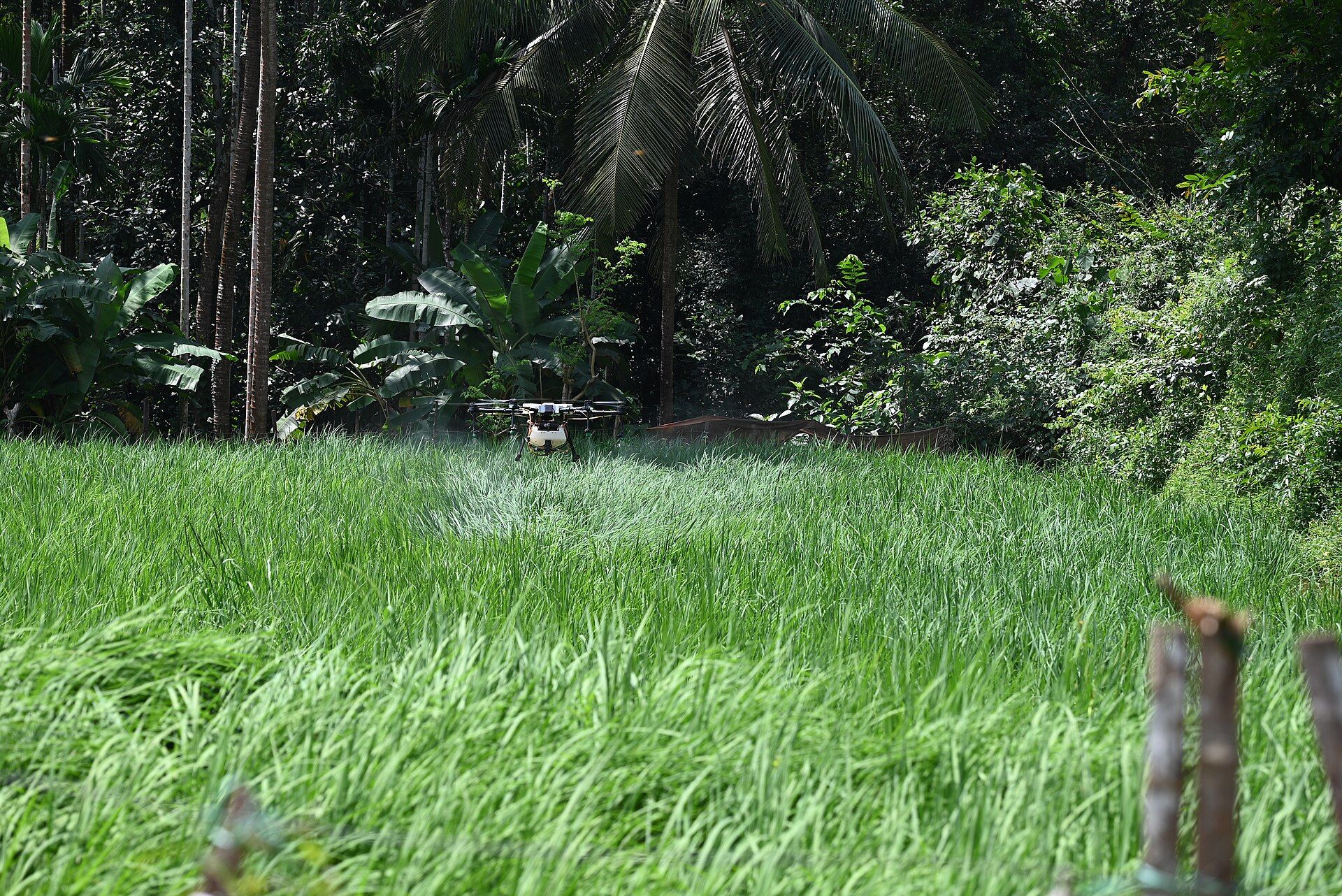
Cover photograph: Shreesha Sharma, CC BY-SA 4.0, via Wikimedia Commons.